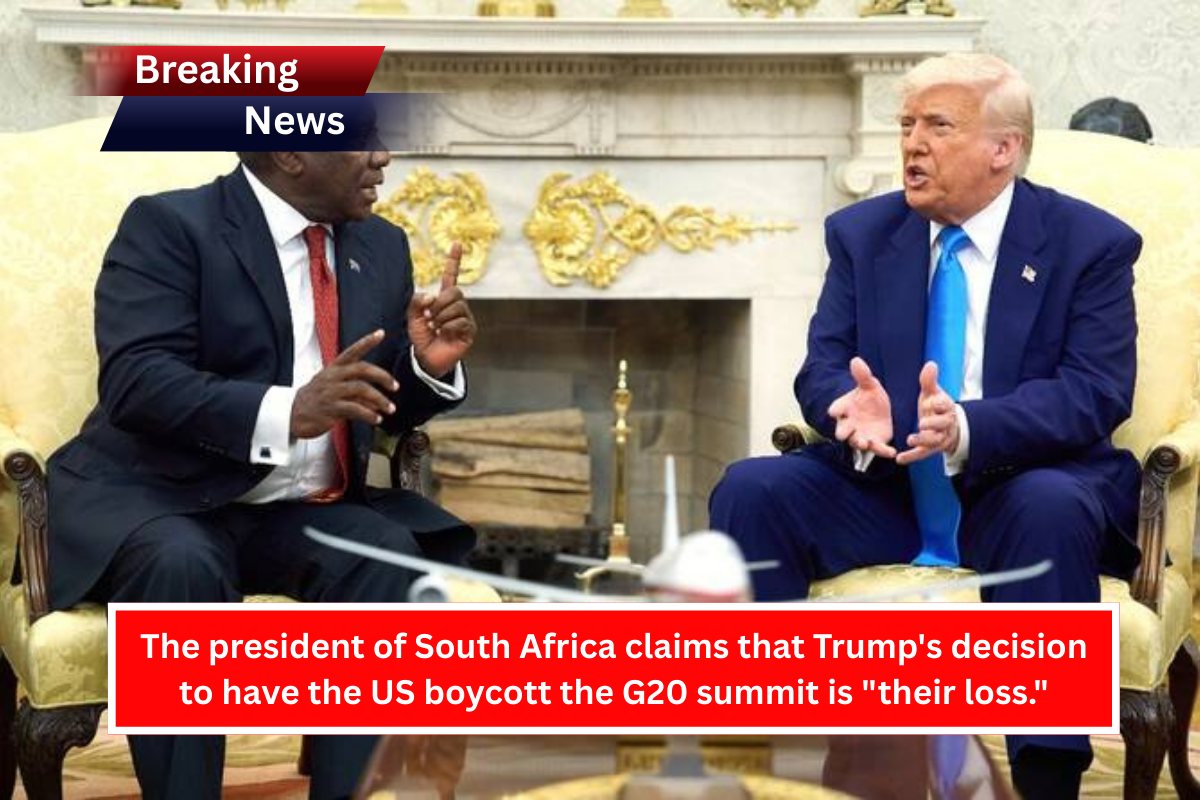
U.S.–South Africa relations have hit a new low after President Donald Trump’s decision to boycott the G20 summit in Johannesburg, South Africa. The move, based on Trump’s repeated and widely disputed claims of anti-white violence in the country, has been met with firm rejection by South Africa’s leadership — and deep concern from global observers.
As South Africa prepares to host the G20 for the first time, President Cyril Ramaphosa has called the U.S. boycott “their loss” and criticised the Trump administration for abandoning its leadership role on the world stage.
South Africa Responds to G20 Boycott
Speaking to reporters outside Parliament, Ramaphosa said:
“The United States needs to think again whether boycott politics actually works, because in my experience it doesn’t.”
He stressed that the summit will go on without the U.S. and that major decisions will still be made by the other participating nations:
“By not being at the G20, the U.S. is giving up the very important role that they should be playing as the biggest economy in the world.”
The G20, made up of the world’s largest economies, was formed in 1999 to address global economic challenges and development issues. The U.S. is expected to take over the rotating presidency of the group at the end of this year — a role that typically requires strong engagement and leadership, not withdrawal.
Why Is Trump Boycotting the Summit?
President Trump announced last week that no U.S. official would attend the G20, blaming what he described as “violent persecution” of white Afrikaner farmers in South Africa. He claimed on his social media platform that these farmers are being “killed and slaughtered” and having their land confiscated due to their race.
These claims mirror talking points from far-right commentators and conservative media in the U.S., but they have been repeatedly debunked by South African authorities, international human rights groups, and local crime statistics.
In May, during a White House meeting, Ramaphosa personally told Trump that his claims were “completely false.” But the issue has remained a talking point for Trump and his allies, including billionaire Elon Musk, who has also accused South Africa’s Black-led government of racism against whites due to affirmative action policies aimed at correcting apartheid-era injustices.
Diplomatic Tensions Rising
Relations between the U.S. and South Africa have continued to sour:
- The South African ambassador to Washington was expelled in March over comments made about Trump.
- U.S. Secretary of State Marco Rubio boycotted a G20 foreign ministers meeting in South Africa earlier this year, criticising the host country’s focus on climate change and inequality as “anti-American.”
Meanwhile, South Africa’s decision to accuse U.S. ally Israel of genocide at the International Court of Justice has further worsened the mood in Washington.
Global Reaction to the Boycott
The United States’ absence at the G20 raises serious concerns about its global credibility and leadership, especially as it prepares to chair the summit next year. Critics say the boycott reflects a growing pattern of Trump-era isolationism — where foreign policy is increasingly shaped by domestic political narratives rather than global cooperation.
Some consequences of the boycott:
- The U.S. will not be part of key global economic talks at a time when coordination is crucial.
- It creates a power vacuum that may be filled by China, Russia, or other nations with competing interests.
- It damages U.S. relations with one of its largest trading partners in Africa.
Ramaphosa Holds Firm
Ramaphosa has not backed down in the face of Trump’s claims. His government has been clear that:
- There is no government-backed campaign of violence against white farmers.
- Crime in South Africa affects all citizens, regardless of race.
- Affirmative action policies are meant to correct historical inequalities, not punish whites.
He said South Africa would continue hosting the G20 with the full participation of other global leaders, including China, India, the EU, and others.
The Trump administration’s decision to boycott the G20 summit in South Africa over unproven claims of anti-white violence has widened the rift between two historically important partners. While South Africa moves ahead with the summit — and assumes its moment of global leadership — the U.S. faces criticism for turning its back on multilateral diplomacy.