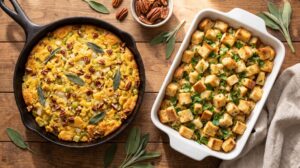
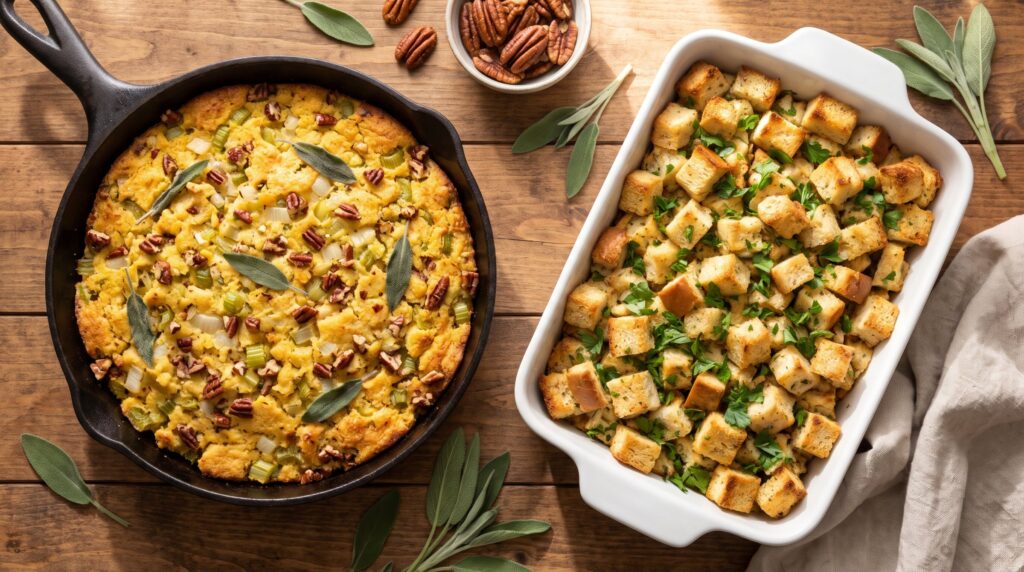
Stuffing or dressing? Before that argument starts at the Thanksgiving table on Nov. 26, here is the real difference: where the dish is cooked, which bread it starts with, and which name your part of the country grew up using.
Photo: AI illustration.
The short answer
Traditionally, stuffing is cooked inside the bird and dressing is baked on its own in a pan. Texas food writer Lisa Fain of Homesick Texan writes that old Texas Thanksgiving recipes followed that rule closely: stuffing always went inside the turkey (or a duck, which she notes was a popular Texas Thanksgiving roast in the 1800s), while dressing was prepared separately.
Today the line is much blurrier. Fain points out that when she lived in New York, most cooks baked the dish outside the turkey and still called it stuffing, even though the only thing it had stuffed was a baking pan. In practice, the name you use says more about where you grew up than how you cook it.
Where you live decides the name
According to the University of Arkansas Cooperative Extension Service, people in the South tend to say “dressing,” while people in the northern states generally say “stuffing.” The extension’s article even shares a Butterball map showing which states lean toward which word. Texas sits firmly on the dressing side of that Southern habit.
The bread is the other big difference
The same extension article says traditional Northern stuffing starts with sturdy white bread, while the most common base for Southern dressing is cornbread. It is not a hard rule, though. Depending on the region, cooks mix white bread with saltine crackers, add oysters along the coast, stir in andouille sausage in Louisiana, or use sourdough and mushrooms in California.
What almost every version shares is the flavor base: onions and celery, plus herbs like sage and thyme.
What makes Texas dressing Texan
Fain writes that most Texas dressings begin with cornbread, often stretched with some wheat bread, and that the bread should be at least a day old so it can soak up the broth. Celery, onion, sage, thyme and parsley are standard, and paprika shows up often.
Her look back at older Texas recipes is the fun part. In the 1800s, Texas dressings often included oysters and chestnuts. By the middle of the 20th century the oysters had faded out and the chestnuts had been swapped for pecans, the state nut. Sausage and bacon are common add-ins, and so are tamales, apples, dried cranberries, fresh corn and green chiles.
Her own jalapeño pecan cornbread dressing is a good template: about 1½ pounds of day-old cornbread plus ½ pound of white bread, 4 cups of broth, roasted pecans, fresh and pickled jalapeños, and 2 beaten eggs, baked uncovered at 350°F for 50 minutes to an hour until browned and set. The full recipe is on Homesick Texan.
Is one safer than the other?
Both have to reach the same temperature. FoodSafety.gov lists 165°F for stuffing cooked inside poultry, and 165°F for casseroles. The difference is how easy it is to get there. Dressing in a pan heats evenly and is simple to check with a thermometer. Stuffing packed in the cavity has to hit 165°F in its center too, not just the turkey around it.
The Arkansas extension adds a few rules that apply to both:
- Prep the dry and wet ingredients ahead if you like, but chill them separately and do not mix them until right before baking or stuffing the bird.
- Keep the mixture moist, not dry. The extension notes heat destroys bacteria faster in a moist environment.
- Put it straight into an oven set no lower than 325°F.
- Check the center with a food thermometer for 165°F, and keep it out of the 40°F to 140°F “danger zone” before and after cooking.
Stuffing vs dressing at a glance
- Stuffing: traditionally cooked inside the turkey; usually white bread; the common name in the North.
- Dressing: baked in a separate pan; cornbread is the usual base in the South and Texas; the common name in the South.
- Both: onion, celery, sage and thyme, and a safe finish at 165°F.
Which one should you make?
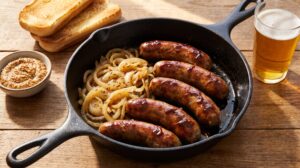
If you want a crisp, browned top and an easier oven plan, bake it in a pan and call it dressing like most Texans do. Our sausage and herb stuffing works baked in a dish, and it shares oven space well with a sweet potato casserole with pecan streusel. If your turkey is going on the smoker this year, read 9 mistakes that ruin smoked turkey first, and keep the dressing in the kitchen oven.