A smoked turkey can be the best thing on the Thanksgiving table or a dry, rubbery letdown, and the difference usually comes down to a handful of avoidable mistakes. With Thanksgiving on November 26 this year, here are the nine that ruin the most birds, plus the fix for each one.
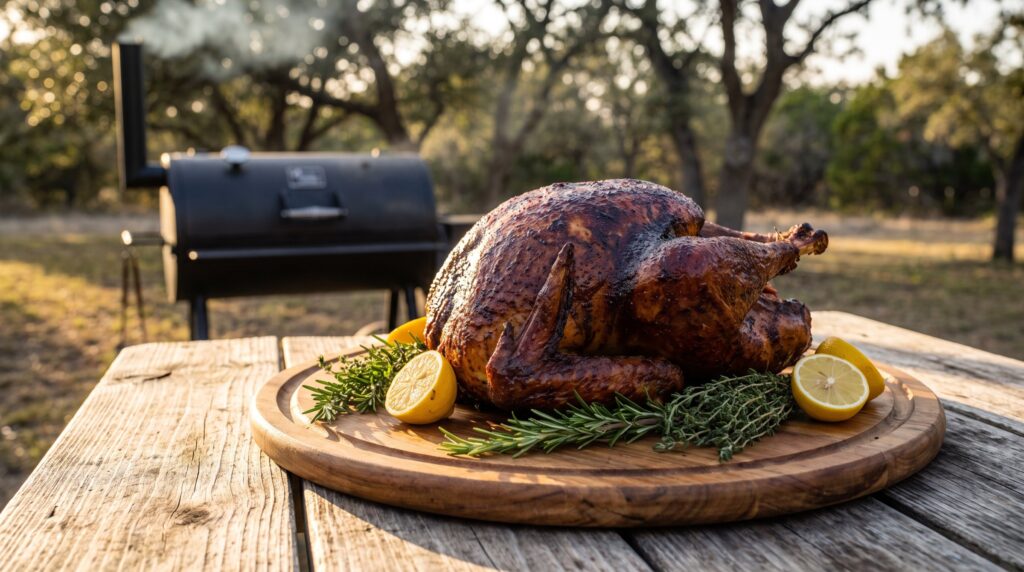
Photo: AI illustration.
Every food-safety number below comes from the USDA’s Food Safety and Inspection Service (FSIS), and the technique tips come from Jeff Phillips of Smoking-Meat.com, who has written about smoking turkey for years. Links are in the Sources box at the end.
1. Putting a Partly Frozen Turkey in the Smoker
This is the big one. The USDA says to completely thaw meat and poultry before smoking, because smokers run at low temperatures and a frozen center takes too long to come up to heat. That leaves the bird sitting in the “Danger Zone” between 40°F and 140°F, where bacteria multiply. A thawed bird also cooks more evenly, so you get juicy breast meat instead of a cooked outside and a cold middle.
The fix: start early. In a refrigerator set at 40°F or below, FSIS says to allow about 24 hours for every 4 to 5 pounds of turkey:
- 4 to 12 pounds: 1 to 3 days
- 12 to 16 pounds: 3 to 4 days
- 16 to 20 pounds: 4 to 5 days
- 20 to 24 pounds: 5 to 6 days
Running late? Cold-water thawing takes about 30 minutes per pound. Keep the turkey in a leak-proof bag, submerge it in cold tap water, change the water every 30 minutes and cook it right away once it is thawed. Never thaw a turkey on the counter.
2. Stuffing the Bird Before It Goes on the Smoker
Stuffing a turkey you plan to roast is already a timing puzzle. On a smoker it is a bad idea. In its guide to cooking turkey on a smoker, the USDA says plainly: do not stuff the turkey. Because smoking cooks at a low temperature, the stuffing can take too long to reach a safe 165°F, and the agency adds that smoked stuffing tastes off.
The fix: bake the dressing in a pan in the oven. If you want aromatics in the cavity, a quartered onion, a few garlic cloves and some herbs add flavor without the risk. Our sausage and herb stuffing is built to bake on its own.
3. Smoking a Wet Bird Straight Out of the Brine
Rubbery skin is the most common smoked-turkey complaint. Jeff Phillips of Smoking-Meat.com points to moisture as the main cause: by the time a holiday turkey has thawed for days, soaked in a wet brine and been seasoned, its skin is carrying a lot of surface water. If that water never dries off, the skin turns soft and chewy instead of bite-through tender.
The fix: after thawing or brining, set the turkey on a rack over a pan and leave it uncovered in the refrigerator for several hours, or overnight. Phillips also notes that a dry brine (salt rubbed on the bird, then an uncovered rest in the fridge) seasons the meat and dries the skin at the same time. His extra trick: mix 1 teaspoon of aluminum-free baking powder with 1 tablespoon of kosher salt, rub it over the bird and refrigerate it uncovered for at least 8 hours before adding your rub.
4. Running the Smoker Too Cold
Brisket loves a long, low cook. Turkey does not need it. The USDA says the smoker’s air temperature should stay between 225°F and 300°F for the whole cook. Drop below that and the bird spends longer in the Danger Zone, and the fat under the skin never renders.
The fix: hold the pit in the 225°F to 300°F window. Phillips says he smokes turkey at about 240°F for the balance of smoke, juiciness and simplicity, and that raising the heat near the end is a good option if crisp skin matters most to you. Just don’t chase perfect skin so hard that you dry out the breast. Juicy meat is the goal.
5. Trusting the Lid Gauge Alone
A smoker’s air temperature tells you nothing about the inside of the turkey. The USDA recommends two thermometers for any smoke: one to watch the smoker’s air temperature, and a food thermometer for the meat. An oven-safe probe can stay in the bird during the cook, and an instant-read thermometer is for spot-checking once it comes off.
The fix: if your smoker has no built-in gauge you trust, the USDA suggests placing an appliance thermometer on the smoker rack before you light it. Then check the turkey itself with a food thermometer.
6. Cooking by the Clock Instead of the Thermometer
The USDA estimates 20 to 30 minutes per pound for a turkey on a smoker, but that is only a starting point. Cooking time changes with the bird’s size and shape, its distance from the heat, the coals and even the outside air. A windy, cold Thanksgiving morning in the Hill Country can add a lot of time.
The fix: use the time estimate to plan your day, then let the thermometer decide when it’s done. Turkey is safely cooked at 165°F in the innermost part of the thigh and wing and in the thickest part of the breast. Check all three spots. Set the smoker out of the wind, which the USDA also recommends, so it holds its temperature.
7. Burning the Wrong Wood
Texans have plenty of wood options, and not all of them belong in a smoker. The USDA warns against softwoods such as pine, fir, cedar and spruce, which give food a turpentine flavor and coat it in black pitch or resin.
The fix: stick to hardwoods or fruitwoods. The USDA names hickory, apple and maple chips as giving the most satisfying smoke flavor. Turkey takes on smoke easily, so a lighter fruitwood like apple is a safe bet if you’re new to it.
8. Cramming a Giant Bird Into a Small Smoker
Airflow carries moisture away from the skin as it cooks. Phillips notes that crowding the cooking chamber, or setting the turkey where air can’t move around it, works against you, which is one reason smaller birds are easier to smoke than huge holiday turkeys.
The fix: buy a smaller turkey (or two), give it room on the grate, or spatchcock it. Flattening the bird exposes more skin to heat and air, cooks it more evenly from top to bottom and, according to Phillips, often gives better skin too.
9. Leaving the Leftovers Out Through the Football Game
A long holiday meal makes it easy to forget the carcass on the cutting board. The USDA says to refrigerate smoked meat and poultry within 2 hours of taking it off the smoker.
The fix: carve the leftovers into smaller portions or slices, pack them into shallow covered containers and refrigerate. Use them within 4 days or freeze them for later.
Quick Smoked Turkey Checklist
- Thaw completely in the fridge: about 24 hours per 4 to 5 pounds.
- Dry brine or wet brine, then air-dry the bird uncovered in the fridge for several hours or overnight.
- Leave the cavity empty and bake the dressing separately.
- Hold the smoker at 225°F to 300°F, out of the wind, with hardwood or fruitwood.
- Plan on 20 to 30 minutes per pound, but pull it at 165°F in the thigh, wing and breast.
- Refrigerate leftovers within 2 hours and use within 4 days.
Planning the rest of the menu? Finish the meal with our Texas pecan pie with a brown butter filling.