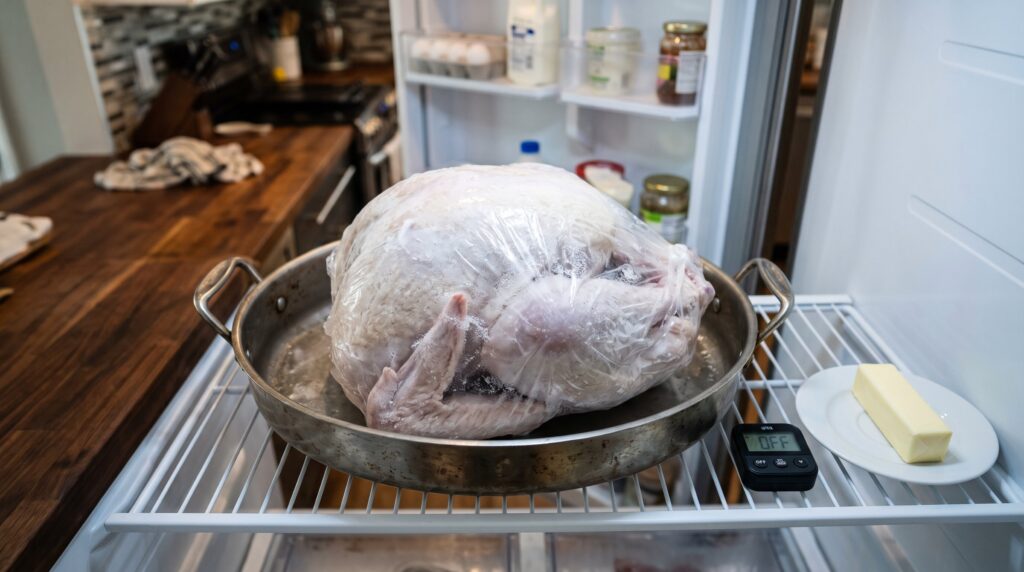
Thanksgiving lands on Thursday, November 26 this year, and if your turkey is frozen, the clock starts about a week before that. A refrigerator thaw takes roughly a full day for every 4 to 5 pounds of bird, so most thawing mistakes come down to timing, temperature or a little too much improvising. Here are the nine we see most often, with the fix for each one, based on USDA food safety guidance.
Photo: AI illustration.
A quick note on terms first: according to the USDA Food Safety and Inspection Service, a “fresh” turkey has never been chilled below 26°F, while a frozen turkey has been taken down to 0°F or colder. Everything below is about that rock-hard frozen bird.
1. Thawing the turkey on the kitchen counter
It feels harmless: the center of the bird is still frozen solid, so how could it go bad? The problem is the outside. In its “Big Thaw” guide, FSIS explains that while the middle stays icy, the outer layer can sit in the “Danger Zone” of 40°F to 140°F, where bacteria multiply quickly. The same goes for a sink full of hot water.
The fix: use one of the three methods USDA calls safe: the refrigerator, cold water or the microwave. Perishable food shouldn’t sit at room temperature for more than two hours.
2. Moving it to the fridge too late
This is the classic one. USDA’s Thanksgiving guidance says to allow about 24 hours of refrigerator time for every 4 to 5 pounds, and FSIS notes that a fridge set at 35°F thaws food more slowly than one at 40°F. A 20-pound turkey that goes into the fridge on Tuesday night will not be ready for Thursday lunch.
The fix: count backward from Thanksgiving. Using the 4-to-5-pounds-per-day rule (and erring toward the slower 4 pounds), here’s roughly when to move the bird from the freezer to the fridge for a Thursday, Nov. 26 meal:
- 8 to 12 pounds: 2 to 3 days, so by Monday, Nov. 23
- 12 to 16 pounds: 3 to 4 days, so by Sunday, Nov. 22
- 16 to 20 pounds: 4 to 5 days, so by Saturday, Nov. 21
- 20 to 24 pounds: 5 to 6 days, so by Friday, Nov. 20
Set it on a tray or in a pan on the bottom shelf so any drips don’t land on other food.
3. Parking it in the garage, on the porch or in the truck
Plenty of Texas households have a spare fridge or a cool garage, and it’s tempting to leave a boxed turkey out there “where it’s cold.” FSIS specifically says never to thaw food in a garage, basement, car, dishwasher or plastic garbage bag, or outdoors and on the porch. Those spots don’t hold a steady safe temperature, and a sunny afternoon can warm them up fast.
The fix: a working refrigerator at 40°F or below is fine, including a garage fridge. A garage floor, a truck bed or a back porch is not.
4. Leaving the thawed turkey in the fridge for days
Starting early is smart, but a refrigerator thaw doesn’t buy unlimited time. Once a turkey has fully thawed in the fridge, USDA says it stays safe for another 1 to 2 days before cooking.
The fix: if you thawed too early, you have an option: FSIS says food thawed in the refrigerator can be refrozen without cooking, though you may lose some quality. Otherwise, plan your thaw so the bird finishes no more than a day or two before you cook it.
5. Doing a cold-water thaw in a leaky bag, or forgetting to change the water
Cold water is the faster fallback, and USDA estimates about 30 minutes per pound for a whole turkey. That still means around 6 hours for a 12-pound bird and 10 hours for a 20-pounder. FSIS says the turkey must stay in a leak-proof package, because a torn wrapper lets bacteria in and lets the meat soak up water, which leaves it watery.
The fix: keep the turkey in its original wrapping (or a sealed bag if the wrapper is torn), fully submerge it in cold tap water, and change the water every 30 minutes until it’s thawed. Set a phone timer; this is not a “set it and forget it” method.
6. Letting a cold-water or microwave-thawed turkey sit around
A fridge-thawed turkey can wait a day or two. A turkey thawed in cold water or in the microwave can’t. FSIS says food thawed in cold water must be cooked right away once it’s fully thawed, and microwave thawing can start to warm or even partly cook some areas, pushing them into the Danger Zone. Both should be cooked before they’re ever refrozen.
The fix: only start a cold-water thaw when you can go straight from the sink to the oven, smoker or fryer. As for the microwave, USDA notes a whole turkey rarely fits in one; if yours does, follow the manufacturer’s defrost directions and cook immediately.
7. Panicking when it’s still frozen on Thanksgiving morning
It happens to the best of us: you reach into the cavity on Thursday morning and hit ice. Don’t move it to the counter or the hot tap to rush things.
The fix: FSIS says it is safe to cook meat and poultry from the frozen state; it just takes about 50% longer than cooking a thawed bird. Push your dinner time back, roast it as-is, and check the temperature in several spots (see No. 9). One exception: a turkey headed for a deep fryer must be completely thawed and dry, so frozen birds belong in the oven. Our guide to turkey frying mistakes explains why.
8. Rinsing the thawed turkey in the sink
Plenty of family recipes start with “rinse the bird.” USDA says washing or rinsing raw turkey is risky because it can splash bacteria around your kitchen, and the safest choice is simply not to wash it.
The fix: pat the turkey dry with paper towels instead. If you do rinse it, clean and sanitize the sink and the counters around it afterward; USDA suggests 1 tablespoon of unscented liquid chlorine bleach per gallon of water for sanitizing surfaces. Wash your hands with soap and water for 20 seconds before and after handling raw poultry.
9. Stuffing it the night before and skipping the thermometer
Prepping ahead is great for sides, not for a stuffed raw bird. USDA doesn’t recommend stuffing a whole turkey at all, and if you do, it says never to stuff it the night before. And no matter how the bird was thawed, its color and the clock can’t tell you when it’s done.
The fix: bake the dressing in its own pan (our cornbread dressing with sausage and sage is built for that). Then use a food thermometer: FoodSafety.gov lists 165°F as the safe minimum for turkey, for stuffing cooked inside poultry and for leftovers. USDA says to check the thickest part of the breast, the innermost part of the wing and the innermost part of the thigh, keeping the probe off the bone.
A simple thaw plan for Thanksgiving week
- Weigh it now. The pounds on the label decide your start date.
- Fridge thaw: about 1 day per 4 to 5 pounds, on a tray on the bottom shelf, then cook within 1 to 2 days.
- Running late: cold water at about 30 minutes per pound, changing the water every 30 minutes, then cook right away.
- Still icy on Thursday: roast from frozen and plan on roughly 50% more cooking time.
- After dinner: USDA says to get leftovers into the fridge within two hours; they keep up to four days there, or two to six months in the freezer for best quality.
Want to free up the oven and the morning? Our make-ahead turkey gravy with roasted wings can be done days before the bird ever leaves the freezer.