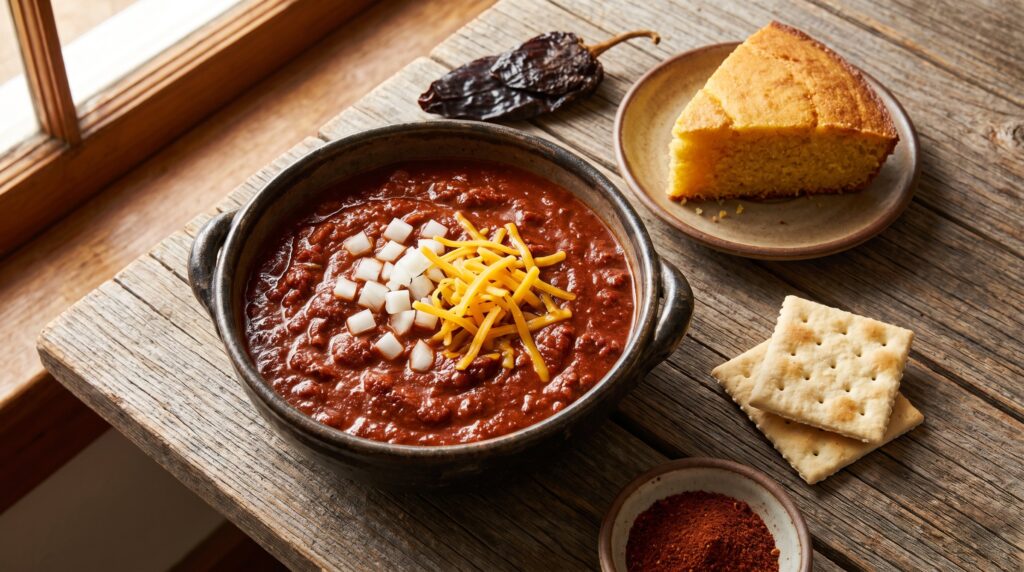
Chili season is here, and in Texas the question at every cook-off and game-day pot is the same: is “Texas chili” just another name for chili con carne, or a different dish? The short answer: Texas chili is a strict, no-beans style of chili con carne, and the details below tell you exactly where the line is.
Photo: AI illustration.
What “chili con carne” means
Chili con carne is Spanish for “chili with meat,” and the name describes the dish plainly: meat cooked in a sauce of chile peppers. The University of Texas at San Antonio’s Institute of Texan Cultures describes the version sold by San Antonio’s “Chili Queens” in the late 1800s and early 1900s as “chilies with meat,” served from food stands in the city’s plazas alongside other Mexican dishes.
According to the same UTSA article, Chef Robert Cantu of the Omni La Mansión del Río in San Antonio points to that chile con carne as the likely origin of Texas chili. A San Antonio chili stand also appeared at the 1893 World’s Fair in Chicago, which helped spread the dish’s fame far beyond Texas.
What Texans mean by “Texas chili”
In Texas, “chili” usually means one specific dish, often called a “bowl of red”: beef simmered in a sauce built on dried red chiles, with no beans. The Texas Legislature made chili the official State Dish in 1977 (House Concurrent Resolution No. 18), “in recognition of the fact that the only real ‘bowl of red’ is that prepared by Texans,” according to State Symbols USA’s summary of the resolution. The resolution also quotes President Lyndon B. Johnson calling chili made outside Texas “a weak, apologetic imitation of the real thing.”
So Texas chili is not a separate dish from chili con carne. It is the Texas rulebook for it.
The real differences, side by side
- Beans: Texas red has none. Elsewhere, the name “chili con carne” is often used for versions with beans too.
- Meat: Texas cooks often use cubed or chunked beef such as chuck. Ground beef is common in everyday chili con carne. Competition rules accept both.
- Chiles: Texas red gets its color and flavor from red chile peppers, usually dried pods or chili powder, rather than from a tomato base.
- Fillers: No rice, pasta or noodles in Texas red. Bean-heavy or pasta-topped chilis belong to other regional styles.
What the cook-off rules say
The clearest written line comes from the International Chili Society, which runs sanctioned chili cook-offs. Its 2025–26 rules define Traditional Red Chili as any kind of meat, or combination of meats, cooked with red chili peppers, and state that “Beans and non-vegetable fillers such as rice and pasta are not allowed.” The rules give no preference to cut, ground, shredded or cubed meat.
Beans are not banned from chili in general, though. The ICS runs a separate Homestyle Chili category, defined as meat and/or vegetables cooked with beans, which may be any color. In other words, even the cook-off world treats bean chili as its own style, not as Texas red.
Where the beans came from
The bean question is older than the arguments about it. The UTSA Institute of Texan Cultures notes that the Chili Queens may have helped popularize adding beans, either because customers asked for them or by combining leftover beans with the chile con carne. Beans were likely used to stretch the dish when meat was scarce or expensive.
How to tell which one you are getting
- A menu that says “Texas red,” “bowl of red” or “Texas-style chili” should mean beef and red chile sauce, no beans.
- “Chili con carne” on its own can mean either style. If beans matter to you, ask.
- “Homestyle” or “chili with beans” means beans are in the pot.
Which one to make this fall
For a Thanksgiving-week supper, a football Saturday or a cook-off entry, Texas red is the one to make, and it is easy to cook low and slow. Our Slow Cooker Texas Chili With Chuck Roast (No Beans) follows the Texas rules, with chunks of chuck and a dried-chile sauce. If you want a dip for the same party, the 15-minute queso dip is another San Antonio classic.
If your family likes beans in chili, go ahead and add them. Just call it chili con carne with beans, or Homestyle, and the Texans at the table will have nothing to argue about.